Homeowners
Replace worn or loose devices, add outlets, install dimmers and smart switches, and fix GFCI problems in kitchens, baths, garages and outdoor areas.
Switches and outlet services including installation, replacement, repairs, GFCI and AFCI protection, dimmers, smart switches, and electrical upgrades.
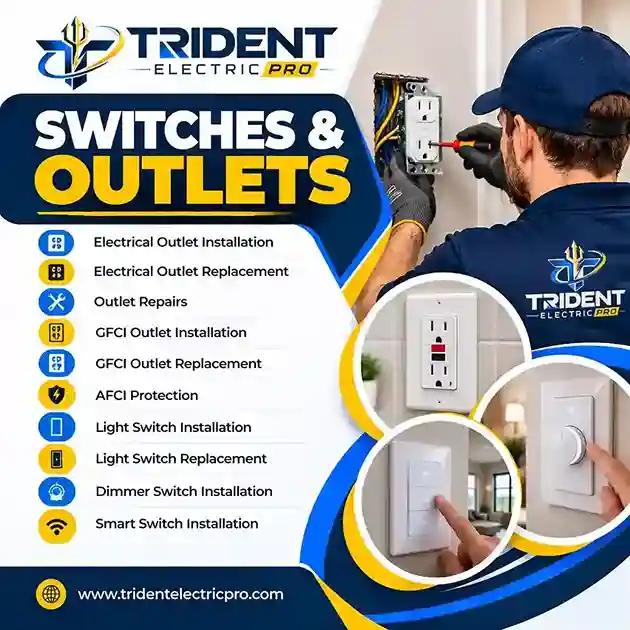
Switches and outlets are among the most frequently used electrical components in a building. Trident Electric provides installation, replacement, troubleshooting, and electrical upgrade work for receptacles, switches, dimmers, GFCI devices, AFCI-related protection, and smart controls.
Best fit: Loose, damaged, dead, outdated, inconvenient, or newly required switches and receptacles, including projects involving additional protection or smart controls.
| Services | Install, replace, repair, relocate and add outlets, switches, dimmers, GFCI/AFCI devices, USB outlets and smart controls |
|---|---|
| Who it is for | Homeowners, landlords, property managers, remodelers and businesses |
| Typical triggers | Dead, loose, warm or buzzing devices; tripping GFCIs; not enough outlets; remodels; smart-home upgrades |
| Cost depends on | Device count and type, new wiring needed, wall and attic access, circuit condition, permit rules |
| How to start | Call (855) 599-0507 or use the contact page; photos of the affected area help |
Last reviewed October 2026 by the Trident Electric team.
Choosing the right device matters as much as the installation. Here is what each one does and where it is commonly used.
| Device | What it does | Common locations |
|---|---|---|
| GFCI outlet | Cuts power when it detects current leaking to ground, reducing shock risk | Kitchens, bathrooms, garages, basements, laundry, outdoors |
| AFCI protection | Detects dangerous arcing that can start fires; installed as a breaker or device | Bedrooms and living areas, depending on local code |
| Tamper-resistant outlet | Shutters block foreign objects from the slots | Homes with children; required in many new installations |
| USB / USB-C outlet | Charges phones and tablets without adapters | Kitchens, bedrooms, offices, bedside and desk areas |
| Weather-resistant outlet | Built to handle moisture and sunlight, used with in-use covers | Patios, porches, exterior walls |
| Dimmer switch | Adjusts light level; must match the bulb type and load | Dining rooms, living rooms, bedrooms |
| Smart switch | App, voice or schedule control; may require a neutral wire | Whole-home lighting and fans |
| Three-way / multi-location switch | Controls one light from two or more places | Stairs, hallways, large rooms |
| Dedicated 20A / 240V receptacle | Serves high-load equipment on its own circuit | Garages, workshops, appliances, EV charging |
Need an outlet where the furniture really goes, a switch at the room entrance, or counter outlets for a remodel? Relocation and new-device work starts with checking circuit capacity, box fill, wall access and the condition of existing wiring.
Older homes may have two-prong ungrounded outlets, aluminum or cloth-insulated wiring, or overloaded circuits. In those cases, replacing the device alone may not solve the problem, and the circuit itself may need work. See electrical wiring and rewiring and panel upgrades for larger fixes.
Replace worn or loose devices, add outlets, install dimmers and smart switches, and fix GFCI problems in kitchens, baths, garages and outdoor areas.
Tenant-turnover device replacement, tamper-resistant and GFCI upgrades, and repair of reported dead or damaged outlets across units.
Office and retail outlet layouts, dedicated equipment receptacles, and device work coordinated with remodeling electrical and commercial electrical projects.
Switches and outlets are among the most frequently used electrical components in a building. Trident Electric provides installation, replacement, troubleshooting, and electrical upgrade work for receptacles, switches, dimmers, GFCI devices, AFCI-related protection, and smart controls.
The right electrical solution depends on the existing system, equipment, circuit capacity, access, project goals, and applicable electrical requirements. Trident Electric's service pages are organized by job type so homeowners, businesses, and property managers can quickly find the closest match.
Service availability, licensing, permitting, and requirements can vary by jurisdiction. When the project is location-specific, use the service-area directory to find the relevant city and state page.
These are useful starting points, not a substitute for an electrical inspection or diagnosis.
Heat, discoloration, buzzing, or a burning smell around an outlet is a warning sign.
A loose receptacle can indicate mounting or connection problems and should not simply be ignored.
A GFCI that trips repeatedly or will not reset may indicate a fault or device problem.
Buzzing, arcing, heat, or unusual operation can indicate a switch or circuit issue.
Permanent electrical needs are better addressed with properly installed receptacles than with chains of extension cords.
Smart switches and dimmers may require specific wiring, neutral conductors, load compatibility, or other conditions.
Determine which switch, outlet, control, or circuit is involved and what is happening.
Evaluate the relevant circuit and connections before replacing components.
Complete the appropriate repair, replacement, or installation.
Check device operation and applicable protection after the work.
Do not replace a device based only on wire color or assumptions about the circuit. A receptacle or switch box can contain multiple circuits or energized conductors.
For electrical faults, panel work, new circuits, high-load equipment, wet-location electrical work, or concealed wiring, a qualified electrical professional can evaluate the system and determine the appropriate next step.
Need a different type of electrical service? Visit the full electrical services directory or browse Trident Electric service areas.
Possible causes include a tripped GFCI upstream, a failed device, a loose or broken connection, or another circuit problem. The circuit should be diagnosed rather than repeatedly replacing the outlet.
Yes. Smart-switch installation depends on the device, wiring, load, box space, and whether a neutral conductor is present. Compatibility is checked before installation.
Repeated GFCI trips can indicate current leakage, a connected appliance problem, moisture, wiring issues, or a worn device. Repeated resets without finding the cause are not recommended.
Yes. Relocating or adding an outlet or switch usually involves routing new cable, checking circuit capacity, and patching access openings. Difficulty depends on wall construction and how close existing wiring is.
Cost depends on the number of devices, the device type, whether new wiring must be run, access to the wall or attic, and permit requirements. Replacing a single device is a smaller job than adding a new circuit. Call (855) 599-0507 to describe the project.
Requirements vary by jurisdiction. Like-for-like device replacement is often treated differently from new circuits or relocations. Ask your local building department, or have a licensed electrician confirm what applies.
A GFCI helps protect people from shock by detecting current leaking to ground and is common in wet or damp areas. An AFCI helps detect arcing conditions that can cause fires and is commonly used on bedroom and living-area circuits. Required locations depend on the code edition adopted locally.
Two-slot outlets often mean there is no equipment ground. Options can include GFCI protection labeled as no equipment ground, or running a grounded circuit. An electrician should evaluate the wiring first.
No. Heat, buzzing, discoloration, or a burning smell can point to a loose connection or overloaded circuit. Turn off the circuit if it is safe to do so and have a qualified electrician inspect it.
Call Trident Electric at (855) 599-0507 to discuss your electrical project or problem. You can also review the service-area directory for location-specific pages.
Call Trident Electric