
Buying an EV
Planning the electrical work before the charger is installed helps identify circuit and capacity requirements.
EV charger installation for homes and businesses, including Level 2 chargers, Tesla chargers, dedicated circuits, panel upgrades, and commercial EV charging.
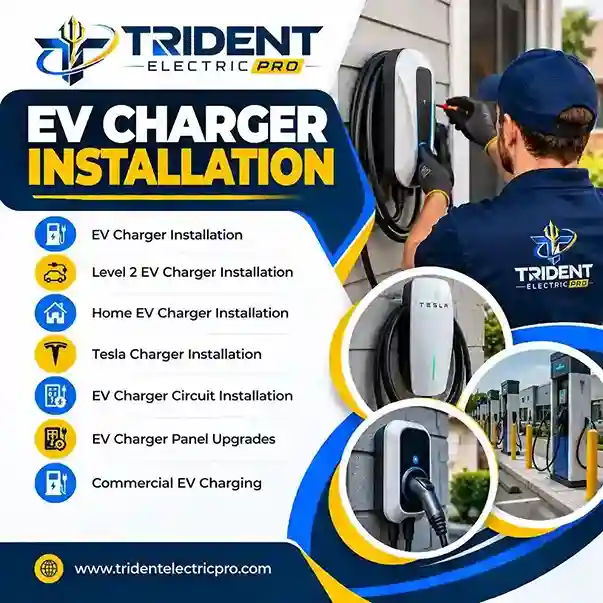
Home and commercial EV charging can add a significant electrical load. Trident Electric provides electrical work for EV charger installations, including dedicated circuits, wiring, equipment connections, and panel or service considerations when required by the project.
Best fit: Projects where an EV charger needs a suitable circuit, wiring, mounting connection, or electrical capacity review before installation.
Home and commercial EV charging can add a significant electrical load. Trident Electric provides electrical work for EV charger installations, including dedicated circuits, wiring, equipment connections, and panel or service considerations when required by the project.
The right electrical solution depends on the existing system, equipment, circuit capacity, access, project goals, and applicable electrical requirements. Trident Electric's service pages are organized by job type so homeowners, businesses, and property managers can quickly find the closest match.
Service availability, licensing, permitting, and requirements can vary by jurisdiction. When the project is location-specific, use the service-area directory to find the relevant city and state page.
These are useful starting points, not a substitute for an electrical inspection or diagnosis.
Planning the electrical work before the charger is installed helps identify circuit and capacity requirements.
Repeated trips can indicate a load, circuit, wiring, or equipment problem.
The charger, vehicle, circuit, and available power all affect charging performance.
An electrical capacity review may be needed before adding a substantial EV load.
Commercial or multifamily charging can require coordinated load and circuit planning.
A new location can require different wiring length, routing, protection, and equipment considerations.
Confirm the EV charger, mounting location, vehicle use, and equipment requirements.
Review the available electrical capacity and circuit requirements.
Complete the charger circuit, wiring, and equipment connections.
Verify the electrical connection and charger operation as appropriate.
EV chargers are substantial electrical loads. Do not connect a high-current charger to an unsuitable receptacle or circuit, and do not improvise wiring or protection to make a charger work.
For electrical faults, panel work, new circuits, high-load equipment, wet-location electrical work, or concealed wiring, a qualified electrical professional can evaluate the system and determine the appropriate next step.
Need a different type of electrical service? Visit the full electrical services directory or browse Trident Electric service areas.
No. It depends on the charger load, existing service capacity, other electrical loads, and the installation requirements.
The electrical portion of a Level 2 installation can include circuit, wiring, protection, equipment connection, and testing as appropriate for the charger and site.
Yes, electrical planning can be performed for commercial and multifamily charging projects, with capacity and circuit requirements considered for the site.
Call Trident Electric at (855) 599-0507 to discuss your electrical project or problem. You can also review the service-area directory for location-specific pages.
Call Trident Electric