Offices & professional spaces
Lighting layouts and controls, receptacle and equipment circuits, panel capacity for added workstations, and wiring changes as teams and floor plans change.
Commercial electrical services for installations, repairs, wiring, panel upgrades, lighting, EV chargers, generators, dedicated circuits and electrical maintenance.
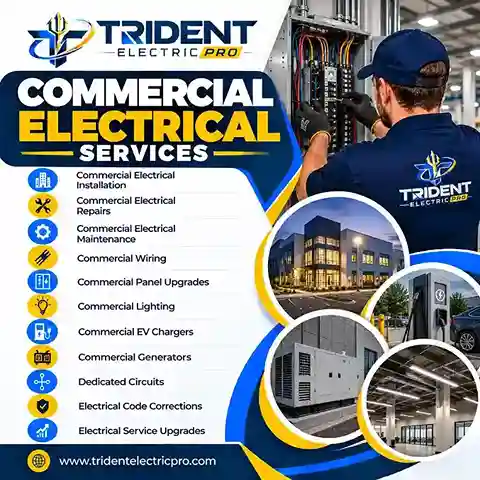
Commercial electrical work has to support the way a business operates, from lighting and receptacles to equipment, panels, EV charging, backup power and ongoing repairs. Trident Electric provides commercial electrical services for installations, upgrades, troubleshooting and electrical projects in business properties, tenant spaces, offices, retail areas and facilities.
Best fit: Business properties, tenant spaces, offices, retail areas, facilities and other commercial projects needing electrical installation, repair, upgrade or maintenance work.
When power or lighting fails in a business, work stops, so commercial electrical work starts with understanding how the space is used: the equipment, the schedule, the people and the building systems that depend on the electrical service. From there we review the existing panels, circuits and wiring, check what capacity is available, and plan the work around the project and applicable requirements.
Commercial projects often involve more people than a home project: a landlord or property manager, other trades, an inspector and sometimes the utility. Good electrical planning accounts for them early. Equipment lead times, shutdown windows and permit steps are easier to manage when they are discussed at the start. See also multifamily electrical services for apartment and residential-property work.
Service availability, licensing, permitting and requirements vary by jurisdiction. Trident Electric is based in Bellevue, Washington; use the service-area directory to find the page for your state.
Every space uses power differently. These are common needs by property type; your project may combine several.
Lighting layouts and controls, receptacle and equipment circuits, panel capacity for added workstations, and wiring changes as teams and floor plans change.
Display and accent lighting, sign and point-of-sale circuits, fixture changes during a refresh, and capacity for new equipment or EV charging for customers.
Dedicated circuits for cooking and refrigeration equipment, GFCI protection where required, and panel capacity when equipment is added or replaced.
High-bay lighting, circuits for shop and dock equipment, subpanels, and backup power for loads that cannot go down.
| Project | What it involves | Planning considerations |
|---|---|---|
| Tenant improvement | New circuits, outlets, lighting and equipment connections for a new layout | Landlord approval, panel capacity, permit and inspection steps, coordination with other trades |
| Lighting upgrade | New or retrofit fixtures, controls and circuits, including exit and emergency lighting | Fixture selection, controls, energy-use goals and code requirements for egress lighting |
| New equipment | Dedicated circuits and connections for kitchen, shop, medical or office equipment | Voltage, phase and amperage from the equipment nameplate; available panel capacity |
| Panel or service upgrade | Replacing or adding panels and subpanels, increasing service capacity | Planned shutdowns, utility coordination, load calculation |
| EV charging | Chargers, dedicated circuits, conduit runs and panel capacity | Number of ports, load management, parking layout, utility service |
| Backup power | Generator wiring and transfer equipment for critical loads | Which loads to back up, fuel type, placement and permits |
| Maintenance & code corrections | Repairs, troubleshooting and fixing items found during an inspection | Documentation of the correction notice, timelines and re-inspection |
| Factor | Typical residential | Typical commercial |
|---|---|---|
| Service and phase | Single-phase, 120/240V | Single-phase or three-phase; building voltages vary (for example 208Y/120V or 480Y/277V) |
| Loads | Lighting, outlets, appliances, HVAC | Large lighting systems, kitchen and shop equipment, motors, data equipment, EV charging |
| Approvals | Owner and permit | Landlord or property manager, permit, inspections, sometimes utility coordination |
| Scheduling | Work around the household | Work around business hours, shutdown windows and other trades |
These are general patterns. The building's actual service and the project's code requirements decide what applies.
Charging for customers, employees or a vehicle fleet is a power project as much as an equipment project. The number of chargers and how fast they charge determine how much capacity the building needs, and the available service often decides how many chargers can be installed without an upgrade.
Load management can let several chargers share a limited supply, and parking layout affects conduit routes and trenching. Review EV charger installation for the full scope.
Many commercial electrical projects require a permit and inspection, and requirements depend on the work and the local jurisdiction. In Washington, electrical work is regulated by the Department of Labor & Industries (lni.wa.gov).
Trident Electric is listed with L&I under electrical contractor license TRIDEEL741D4 (UBI 606135927); you can verify the license on the L&I website. Licensing and permit rules differ by state, so confirm the requirements for your project location.
These are useful starting points, not a substitute for an electrical inspection or diagnosis.
Electrical faults can disrupt operations and should be diagnosed rather than repeatedly reset.
New layouts may require new circuits, lighting, outlets and equipment connections.
Commercial lighting changes can involve fixtures, controls, circuits and energy-use goals.
Equipment additions may require dedicated circuits or capacity evaluation.
Commercial charging projects can require coordinated circuit and capacity planning.
Critical business loads may require a planned generator or backup-power electrical system.
Frequent trips can mean the circuit or panel has reached its limit as equipment has been added.
Items flagged by an inspector or insurer need to be corrected and documented.
Identify the business use, equipment, schedule and electrical goals for the project.
Evaluate panels, circuits, wiring, lighting and other relevant electrical equipment and capacity.
Coordinate the electrical work around the business project, landlord requirements and permit steps.
Verify the completed electrical work and coordinate inspection and any final project needs.
Commercial electrical systems can include higher loads, multiple panels, equipment connections and operational constraints. Do not modify commercial electrical equipment without proper training and authorization.
For electrical faults, panel work, new circuits, high-load equipment, wet-location electrical work or concealed wiring, a qualified electrical professional can evaluate the system and determine the appropriate next step. In an emergency such as fire, call 911.
Photos of the affected area are useful when it is safe to take them. Never open energized equipment to take a photo.
Commercial services include repairs, installations, wiring, panels, lighting, dedicated circuits, EV charging, generators and other electrical upgrades within the project scope.
Electrical work can be coordinated with remodeling or tenant-improvement projects, including new circuits, lighting, outlets and equipment connections. Early planning with the landlord, property manager and other trades helps.
Many do, particularly when adding equipment, EV chargers, heating, lighting or other substantial loads. The existing panel, service size and available capacity are checked before new loads are added.
Many do. New circuits, panel changes and service upgrades commonly require a permit and inspection, and requirements depend on the project and jurisdiction. The Washington State Department of Labor & Industries publishes the state's electrical rules.
Homes almost always use single-phase power. Commercial buildings may use single-phase or three-phase service, and some equipment such as large motors, kitchen equipment or HVAC is built for three-phase. The building's service type affects what equipment and circuits are possible.
Yes. Tenant spaces often need approval for panel access, shutdowns or building-system changes. Share your landlord or property manager contact when you call so those steps can be planned.
The property address and type, the scope of work, a floor plan if you have one, equipment specifications including voltage and phase, photos of the panel or affected area, and your target timeline. Landlord requirements help too.
Yes. Commercial EV charging and generator or backup-power electrical work are part of commercial service, including circuits, panel capacity and transfer equipment. See the EV charger and generator service pages for details.
Trident Electric is based in Bellevue, WA and has service-area pages for states across the United States. Availability and licensing requirements depend on the project location, so call (855) 599-0507 to confirm service for your address.