Frequent breaker trips
Repeated trips can indicate a circuit or load issue that should be diagnosed rather than simply using larger breakers.
Safer, higher-capacity power for homes, businesses, additions, and renovations. We evaluate your loads, replace or upgrade the panel, label every circuit, and test the finished system.
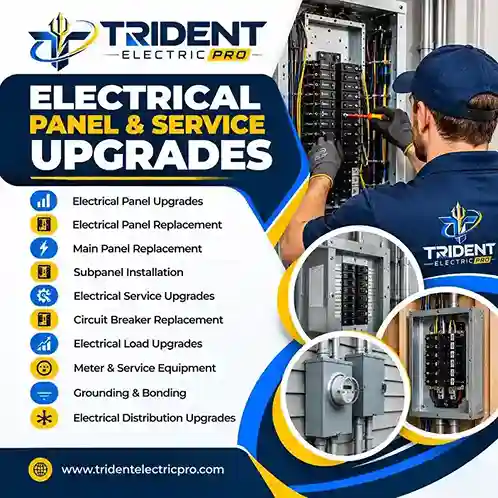
An electrical panel upgrade replaces or enlarges the main breaker panel (and, when needed, the meter base and service entrance) so your property can safely carry more electrical load. Homeowners typically upgrade to 200 amps when a panel is full, outdated, or damaged, or before adding an EV charger, heat pump, addition, or hot tub.
Best fit: aging, undersized, damaged, overloaded, or fuse-based electrical panels and service arrangements.
| Common service sizes | 100A, 150A, 200A, and 400A |
|---|---|
| Typical cost | Often about $1,500–$4,500 for a straightforward 200A panel replacement; service-entrance, relocation, or 400A work costs more |
| Typical timeline | Often one working day for a panel swap; longer when utility coordination is needed |
| Permit & inspection | Normally required; confirmed with the local authority before work starts |
| DIY? | No. Panel interiors can stay energized; use a qualified electrician |
| Get a quote | (855) 599-0507 |
Last reviewed October 8, 2026. Cost and timeline figures are general ranges, not a quote.
The panel is the point where power enters a building and is divided into protected circuits. When it runs out of space, shows heat or corrosion damage, or cannot support new equipment, patching around it only adds risk. Trident Electric sizes the upgrade to the existing system, planned equipment, and the electrical requirements that apply where you are.
Our panel and service upgrade work covers the full chain: the main breaker and bus, individual breakers and AFCI/GFCI protection where required, grounding and bonding, feeders to subpanels, and coordination of the meter base and service entrance when the utility is involved.
Service availability, licensing, permitting, and requirements vary by jurisdiction. For a location-specific project, use the service-area directory to find the relevant city and state page.
These are useful starting points, not a substitute for an electrical inspection or diagnosis.
Repeated trips can indicate a circuit or load issue that should be diagnosed rather than simply using larger breakers.
A full panel limits practical options for adding circuits and may require a planned upgrade.
Fuse-based and low-capacity services are a leading reason for upgrades and often draw insurer and buyer attention.
A remodel or addition can materially change electrical loads and circuit requirements.
EV chargers, heat pumps, electric ranges, hot tubs, and baseboard heat may require a capacity review.
Scorch marks, corrosion, moisture, buzzing, or hot breakers call for prompt professional evaluation.
Certain older brands, such as Federal Pacific Stab-Lok and Zinsco, have documented breaker reliability concerns and are commonly flagged by inspectors.
When lights dim as large appliances start, the service or a connection may be under strain.
Safety note: if you smell burning, see sparks, or find a hot or wet panel, turn off power only if it is safe to do so, stay clear, and call emergency services or the utility if there is any fire risk.
These terms are often mixed up. Each solves a different problem.
| Option | What it is | Best when |
|---|---|---|
| Panel replacement | New main panel on the existing service rating | The panel is old, damaged, recalled-brand, or unreliable but capacity is adequate |
| Panel capacity upgrade | New panel plus a larger service rating (for example 100A to 200A) | Loads are growing: EV charger, heat pump, addition, electric cooking |
| Subpanel | Secondary panel fed from the main panel | A garage, addition, shop, or ADU needs its own circuits and the main has room to feed it |
| Service upgrade | Meter base, mast or service entrance, and utility connection | Higher amperage or a damaged service entrance requires work outside the panel |
| Breaker or circuit correction | Targeted repair of breakers or circuits | The panel is sound and a specific circuit is faulty or overloaded |
A load calculation, not square footage alone, determines the correct service size.
| Service size | Typically suits | Consider upgrading when |
|---|---|---|
| 100 amps | Smaller homes with gas heat and cooking and few large loads | You add central A/C, an EV charger, or electric heat |
| 150 amps | Mid-size homes with moderate electric loads | You plan more than one major new load |
| 200 amps | Most modern homes; a common target for EV charging and heat pumps | Standard choice for a full-capacity upgrade |
| 400 amps | Large homes, multiple EVs, ADUs, or all-electric properties; some commercial uses | Heavy loads or a large addition; often involves utility coordination |
Not sure which applies? Call (855) 599-0507 and we will walk through your equipment and plans.
Most upgrades are triggered by a new load. Plan the panel and the equipment together.
A Level 2 charger is a continuous, high-current load. Depending on your panel, we may add a dedicated circuit, use load management, add a subpanel, or upgrade the service. See EV charger installation.
New rooms add lighting, outlets, and often heating. Sizing the panel in the planning stage avoids opening walls twice. See home addition electrical and remodeling electrical.
Heat pumps, electric ranges, dryers, and baseboard heaters can push a 100-amp service to its limit. We check demand before recommending equipment.
A new panel is the ideal moment to add a generator transfer switch or whole-house surge protection so your electronics and appliances are protected at the source.
Published 2026 cost guides commonly show about $1,500 to $4,500 for a straightforward 200-amp panel replacement. Your price depends on the factors below.
We review the existing panel, the planned loads, and the service arrangement before giving a written scope and price. That keeps surprises off the invoice and lets you compare quotes on equal terms.
Ask any electrician: is the permit included, is the meter base included, and are new breakers and surge protection part of the price?
Request a Written EstimateNever remove a panel cover or work inside a service panel as a DIY project. Parts of the panel can remain energized even when individual breakers are switched off. Do not install a larger breaker simply to stop nuisance tripping.
For electrical faults, panel work, new circuits, high-load equipment, wet-location electrical work, or concealed wiring, a qualified electrical professional can evaluate the system and determine the next step.
 Electrical Wiring & RewiringNew circuits, 240V runs, and whole-home rewiring.EV Charger InstallationLevel 2 chargers on safe, dedicated circuits.Generator & Backup PowerStandby generators and transfer switches.
 Surge ProtectionWhole-house protection at the panel.
 Home Addition ElectricalPower, circuits, and panel capacity for new space.
 Remodeling ElectricalKitchens, baths, and basements done right.
 Electrical RepairsDiagnose tripping breakers and power loss.
 Commercial ElectricalPanels, lighting, and dedicated circuits for business.
Need a different type of electrical service? Visit the full electrical services directory or browse Trident Electric service areas.
Most straightforward residential panel replacements fall roughly between $1,500 and $4,500, based on commonly published 2026 cost guides. Moving the panel, replacing the meter base or service entrance, upgrading to 400 amps, trenching, or utility coordination can raise the total. Trident Electric provides a written quote after reviewing your panel and loads.
A like-for-like panel replacement is often completed in one working day, with power off for part of that time. Service upgrades that involve the meter, service mast, or utility disconnect and reconnect can take longer because scheduling depends on the utility and the inspector.
In most jurisdictions, yes. Panel and service work normally requires an electrical permit and an inspection, and unpermitted work can cause problems with insurance or a future home sale. Requirements vary by city and county, so the permit path is confirmed before work begins.
Amperage is the maximum current the service and panel are rated to carry. 100-amp service suits smaller homes with limited electric loads, while 200-amp service is the common choice for modern homes with EV chargers, heat pumps, electric ranges, hot tubs, or additions. A load calculation determines the right size.
Common signs include frequent breaker trips, no open breaker spaces, a fuse box or 60-amp service, scorch marks, rust or moisture inside the panel, buzzing or a burning smell, flickering lights under load, and panel brands with documented breaker reliability concerns. Planned loads such as an EV charger or addition can also trigger an upgrade.
Not necessarily. It depends on available capacity, the charger requirements, existing loads, and the electrical service. A load evaluation can determine the appropriate approach, which may be a new dedicated circuit, load management, a subpanel, or a full panel upgrade.
Not automatically. The correct solution depends on the panel, service, available capacity, project needs, and applicable requirements. Options can include reorganizing circuits, using approved space-saving breakers where permitted, adding a subpanel, or replacing the panel.
It can. Additions may increase electrical demand and require new circuits or changes to panel capacity and distribution. Planning the panel together with the addition's wiring, heating, and lighting avoids paying for the same work twice.
No. Parts of a service panel remain energized even with the main breaker off, and mistakes can cause shock, arc flash, or fire. Panel work should be done by a qualified electrician under a permit and inspected by the local authority.
A fuse box is a common reason to upgrade, and many insurers and buyers prefer a modern breaker panel. Knob-and-tube or other legacy wiring is evaluated separately during the walkthrough because it may call for rewiring in addition to the panel.
Serving homeowners, businesses, and property managers. Find your city on the service-areas page.
Call (855) 599-0507 to discuss your panel, planned equipment, or project timeline.
Call Trident Electric